Friday, February 16, 2018

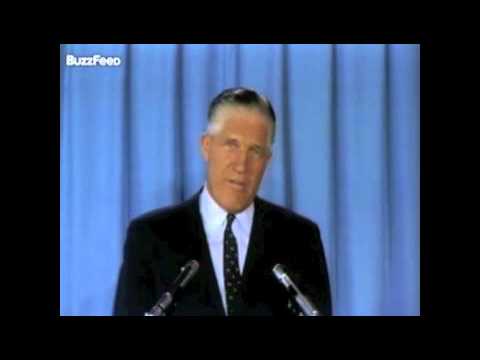
Deborah Gordon: Governor George Romney- 1968 Interview by Lou Gordon: 'Brainwashed in Vietnam'

Source:Deborah Gordon- Michigan Governor George Romney, being interviewed by Detroit journalist Lou Gordon about Vietnam, in 1968.
Source:The Daily View

"George Romney Interview by Lou Gordon on being brainwashed on Vietnam. 1968."

From Deborah Gordon

Governor George Romney not only telling Lou Gordon that he was against America’s involvement in the Vietnam War in 1968, but that he had been brainwashed. Which is a very interesting point and for these reasons. Prior to Watergate and the Vietnam War, Americans tended to trust what their government was telling them until they saw real information that contradicted that. The Silent Generation is probably the last generation that tended to believe what their government was telling them.

The Vietnam War and Watergate, go up to the Iran Contra in the 1980s, and Bill Clinton scandals minor and major, real and fake, from the 1990s and of course that started to change. If Americans were to believe what their government was telling them, they need real hard information and facts first before they believe what their Representative or Senator, or President is saying. Americans today are more inclined to believe that their politicians are lying to them when they’re attempting to sound factual, than they’re simply just wrong or actually telling the truth.

But why do Americans tend to believe their government is lying to them, or at least not telling them the truth? Go back to the mid and late 1960s with President Lyndon Johnson over the Vietnam War, where President Johnson and his National Security Council were saying how great the Vietnam War was going and that we were winning that the Communist Vietnamese were close to surrendering. When the fact any solider or marine on the ground in Vietnam fighting for America and to free Vietnam from communism, knew the opposite was true. The Americans won the battles but the Communists were winning the war and holding their territory with Americans taking a lot of causalities and injuries.

What Governor Romney was telling journalist Lou Gordon in 1968 about his trip to Vietnam and what he personally saw there as far as the war there, was that America wasn’t wining this war even though that is what the American military and foreign affairs officers were telling Governor Romney is that America was winning. So Romney thought he was being brainwashed by his government officials there which is why he came out against America’s involvement in the Vietnam War after supporting it before.

Thursday, February 15, 2018

Andrew Kaczynski: Governor George Romney- 1968 Presidential Campaign Announcement

Source:Andrew Kaczynski- Governor George Romney, announcing his 1968 campaign for President.
Source:The Daily View

"George Romney 1968 Presidential Announcement."

From Andrew Kaczynski

I love this George Romney speech because this is exactly what the Republican Party was once about at least, with a solid conservative-libertarian faction led by Senator Barry Goldwater and others. If this was the GOP today, I might be a Republican myself. And this coming from a JFK Liberal Democrat.

Just listen to this video of Governor Romney’s speech. He was talking about progressive solutions to real problems in America like Welfare and poverty, as well as fiscal situation in the country and the need for fiscal responsibility, but calling for progressive federalist solutions to these problems.

Governor Romney and Richard Nixon sound very similar on these issues because they were both part of that old progressive center-right wing of the Republican Party. Republicans who believed that progress could be made with government, but that it had to be limited and the states and localities had to be part of the solutions. Instead of setting up big Federal programs run by Big Government to serve every state especially the people who live in those states. Which was also a problem for Governor Romney because he and the GOP frontrunner Richard Nixon, sounded very similar on economic policy.

Governor Romney arguing for Welfare reform and federalism in 1968. President Richard Nixon in 1969 proposed Welfare reform and what he called a New Federalism. Which was about ( to use a Washington term ) block granting the New Deal and Great Society safety net and antipoverty programs over to the states and allowing for the states to run them.

Which was the middle position between the George McGovern McGovermite Democratic Socialists in the Democratic Party who believed that not only should the Federal Government continue to run these programs, but that they should be expanded and that new programs should be created on top of the New Deal and Great Society and that taxes should be raised on everyone to pay for them. And the Conservative Libertarians in the GOP led by Barry Goldwater, arguing that these programs shouldn’t exist at all.

The only real difference that George Romney had with Richard Nixon, had to do with the Vietnam War. Romney arguing that the war was a failure and that it was time for America to get out of it. And there just wasn’t enough Republican voters back then to line up and vote for Romney on that issue.

If anything Republicans back then believed the war need to be fought better and that we should go harder in Vietnam. But George Romney represents the old Progressive-Federalist wing of the Republican Party along with Nelson Rockefeller who also ran for President in 1968, at a time when that faction of the party was starting to get smaller.

Wednesday, February 14, 2018

CBS News: Face The Nation- Governor George Romney: 'Addresses 1964 Republican National Convention'

Source:Face The Nation- Governor George Romney, speaking to the 1964 Republican National Convention, talking about right-wing extremism.
Source:The Daily View

"George Romney addresses 1964 Republican convention. The Governor of Michigan urged Republicans at the 1964 GOP convention to reject "extremism."

From Face The Nation

What I get from this short five minute version of Michigan Governor George Romney speaking at the 1964 Republican National Convention, is that he wasn’t necessarily against Senator Barry Goldwater and his presidential campaign. But he was worried about the Republican Party moving right and even Far-Right.

From 1964-68, the GOP was moving in transition from a center-right moderate conservative party with a solid progressive Northeastern base that Governor Romney was part of, to expanding the base of the party and moving south as well as west. Bringing in Christian-Conservatives from the South and Conservative-Libertarians from the West. Barry Goldwater was one of those Western Conservative-Libertarians.

Governor Romney and Governor Nelson Rockefeller and other Progressive Republicans, were worried that America wasn’t ready for this hardcore what was called back then conservative message,  but what today would be a conservative-libertarian message as far as Goldwater that was about individual freedom both economic and personal, as well as limited government and personal responsibility, as well as federalist when it came to government. And as a result the GOP would get wiped out in the 1964 general elections which was exactly what happened. And they were worried that the GOP couldn’t compete with just a small percentage of the electorate.

What Rockefeller and Romney got wrong, was that they were only correct in the short-term. Millions of Southern Democrats who voted for President Lyndon Johnson in 1964, voted for Richard Nixon for President in 1968. Congressional Republicans had a big comeback in 1966 by winning in the South in the House and Senate and winning out west.

Richard Nixon was part of the Progressive Republican base in California and New York, but being the great politician that he was, was also able to communicate with Goldwater Conservatives and Christian-Conservatives in the South, while retaining his Northeastern Republican Progressive base, to win the presidency in 1968 and win going way reelection in 1972.

But the remaking and renovation of the modern GOP that we see today started in 1964. Romney and Rockefeller, were wrong about the long-term affects that moving right would have on the GOP.

Tuesday, February 13, 2018

Thom Hartmann: Thom Hartmann Interviewing Gianno Caldwell- Where Are The Nelson Rockefeller Republicans?

Source:Thom Hartmann- Governor Nelson Rockefeller (R, New York) running for President, perhaps in 1960.
Source:The Daily View

"Thom Hartmann talks with Gianno Caldwell, Republican Strategist-Caldwell Strategic Consulting, Website: Gianno Caldwell.

If you liked this clip of The Thom Hartmann Program, please do us a big favor and share it with your friends... and hit that "like" button!"

From Thom Hartmann

The first few minutes of this interview is about Donald Trump and takes place in 2015. I’m not interested in Donald Trump for this piece, but if you are then you’re welcome to watch the video.

But I am interested in Nelson Rockefeller and what was the progressive wing of the Republican Party at least from the 1950s through the 1970s and perhaps even 1980s.

Nelson was a Progressive Republican along with Governor George Romney and a few Congressional Republicans like Senator Jacob Javits, Senator Charles Matthias, even President Richard Nixon and perhaps even Dwight Eisenhower when it came to economic policy and civil rights.

The Republican Party use to represent the Northeast and Midwest and had a conservative-libertarian wing in the West like Senator Barry Goldwater and others. Thanks to the civil rights movement of the 1960s and the 1960s in general , you saw Southerners who were anti-civil rights and anti-desegregation Democrats, move to the Republican Party. With Northern Republicans moving to the Democratic Party.

I wouldn’t say the Rockefeller Progressive wing of the Republican Party is dead, but certainly on political life support. Senator Susan Collins., Governor Larry Hogan of Maryland, Representative Charlie Dent and perhaps 30-40 House Republicans. But the Republican Party today is essentially Southern Bible Belt Christian-Conservative party, with conservative-libertarian wing in the west led by Senator Jeff Flake and others.

With a pro-business Northeastern wing of the Republican Party that is progressive if not liberal on social issues or at least neutral, but pro-business and wanting to see taxes and regulations down on business other than the environment and when it comes to safety.

Monday, February 12, 2018

Dartmouth College: Michael A. Cohen- Nelson Rockefeller: 'The 1968 Election & The Disappearance of Moderate Republicans'

Source:Dartmouth College- Professor Michael Cohen, giving a lecture about 1968 and the Republican Party.
Source:The Daily View

"Michael A. Cohen, Columnist, The Boston Globe, "Nelson Rockefeller ...

... the 1968 Election & the Disappearance of Republican Moderates." Book signing following talk: American Maelstrom: The Election of 1968 and the Politics of Division."

From Dartmouth College

I disagree with Michael Cohen right off the bat in his lecture about Nelson Rockefeller. Nelson wasn’t a Moderate, but was a Progressive and a Progressive Republican. Progressives in the real sense might look like Moderates compared with Socialists on the Far-Left who expect the national government to do practically everything for people. And in the case of Communists, want the national government to literally do everything for everybody. Perhaps even check people’s shoes to make sure they are tied correctly before the central government allows for people to leave their homes.

And Libertarians on the Right and if you’re talking about Anarchists on the Left, who don’t want government to do anything for everybody. That government in any form is corrupt and incompetent, and a form of enslavement.

Michael Cohen made my point that Nelson was a Progressive in his own lecture when he said that Rockefeller was a doer. He believed in government and that government can create positive change and do positive things for people. What do Progressives believe? They believe that progress can be made through government action. Limited government action since Progressives aren’t Socialists or Communists, and they are not even Liberals. Less ideological than Liberals and really everyone who is not a Moderate or Centrist and stress individual rights and individualism less than Liberals.

By the time 1968 comes around Richard Nixon essentially takes over the Republican Party in order to not just win the presidential election, but to serve him politically. By campaigning strongly for Congressional Republicans in 1966 and contributing to their comeback both in the House and Senate and making the GOP players in Congress again.

But also with Richard Nixon campaigned in the South that was traditionally Democrat, but Dixiecrat and even Confederate, and even religious as far as how they looked at their politics. What we today call the Christian-Right comes to the Republican Party by the late 1960s thanks to Richard Nixon and others. With Northeastern Republicans leaving the GOP except for Nelson and a few others and become Democrats. Which left Nelson Rockefeller without a major political party to run for president for.

Sunday, February 11, 2018

CBS News: Face The Nation- Flashback: U.S. Senator Frank Cannon- 'On Governor Nelson Rockefeller & Conflicts of Interest- In 1974'

Source:Face The Nation- U.S. Senator Frank Cannon, on CBS News Face The Nation in 1974, talking about President Gerald Ford's Vice Presidential nominee, Governor Nelson Rockefeller.
Source:The Daily View

"Then-Sen. Howard Cannon tells "Face the Nation" in 1974 how lawmakers were approaching concerns about Nelson Rockefeller's business empire and the conflicts of interest it might pose if he became vice president."

From Face The Nation

President Richard Nixon resigns the presidency in August of 1974 because of Watergate and his involvement in covering up that scandal coming to light because of his tapes. The House Judiciary Committee votes to impeach President Nixon that month as well with House Democrats clearly having the votes to impeach President Nixon by the full house.

The Senate Republican Leadership led by Minority Leader Hugh Scott, with other GOP Senators like Senator Barry Goldwater, goes to the White House to meet President Nixon and tell him that he’ll be impeached by the House and then convicted in the Senate. There were Senate GOP whip counts back then with only 20 votes or so in the Senate to vote for President Nixon’s acquittal. So this is a little background for why Governor Nelson Rockefeller from New York, was up for appointment by President Gerald Ford to be Vice President in the first place.

After the Congressional elections of 1974 where House Democrats add to the majority and pick up around 40 seats and Senate Democrats add 6 seats to their majority, President Gerald Ford appoints Governor Rockefeller to replace him as Vice President. If you’re familiar with this era or lived through it you know that Gerry Ford was President Nixon’s last Vice President and was appointed to that office in the fall of 1973.

But Nelson Rockefeller wasn’t your ordinary Governor. He’s part of the Rockefeller family dynasty and was worth what would probably be in today’s dollars in the hundreds of millions of dollars. He had a lot of business interests and at least potential conflicts of interest. When a new Vice President is needed and appointed before a presidential election, that person has to be confirmed by the entire Congress, not just the Senate. Which means the House gets to vote on the Vice Presidential nominee as well.

So that is what this Face The Nation interview was about in 1974 and while they were interviewing Senator Howard Cannon who was Chairman of the Rules Committee with his committee having jurisdiction over the Vice Presidency and vice presidential appointment.

And what the reporters on Face The Nation including a very young, beautiful, and adorable, Connie Chung from CBS News ( I must say ) interviewing Senator Cannon about Governor Rockefeller and his potential conflicts of interest because Rockefeller was such a wealthy man and had money and investments all over the country. They were asking Senator Cannon what he believed his committee would do as far as looking into those potential conflicts.

Saturday, February 10, 2018

The Film Archives: Book TV- U.S. Representative Bobby Rush Interviewing Catherine Wilkerson: 'The Legacy of The Weather Underground & The New Left Movement of The 1960s'

Source: The Film Archives- Unknown woman who perhaps was part of the socialist Weather Underground from the late 1960s and early 1970s.
Source:The New Democrat 

"Students for a Democratic Society (SDS) was a student activist movement in the United States that was one of the main representations of the New Left. The organization developed and expanded rapidly in the mid-1960s before dissolving at its last convention in 1969."

From The Film Archives

From Wikipedia about The Weather Underground.

"The Weather Underground Organization (WUO), commonly known as the Weather Underground, was an American militant radical left-wing organization founded on the Ann Arbor campus of the University of Michigan. Originally called Weatherman, the group became known colloquially as the Weathermen. Weatherman organized in 1969 as a faction of Students for a Democratic Society (SDS)[2] composed for the most part of the national office leadership of SDS and their supporters. Their goal was to create a clandestine revolutionary party to overthrow the U.S. Government.[3]

"With revolutionary positions characterized by black power and opposition to the Vietnam War,[2] the group conducted a campaign of bombings through the mid-1970s and took part in actions such as the jailbreak of Dr. Timothy Leary. The "Days of Rage", their first public demonstration on October 8, 1969, was a riot in Chicago timed to coincide with the trial of the Chicago Seven. In 1970 the group issued a "Declaration of a State of War" against the United States government, under the name "Weather Underground Organization".[4]

The bombing campaign targeted mostly government buildings, along with several banks. The group stated that the United States government had been exploiting other nations by waging war as a means of solidifying America as a greater nation. Most were preceded by evacuation warnings, along with communiqués identifying the particular matter that the attack was intended to protest. No people were killed in any of their acts of property destruction, although three members of the group were killed in the Greenwich Village townhouse explosion.

For the bombing of the United States Capitol on March 1, 1971, they issued a communiqué saying that it was "in protest of the U.S. invasion of Laos". For the bombing of the Pentagon on May 19, 1972, they stated that it was "in retaliation for the U.S. bombing raid in Hanoi". For the January 29, 1975 bombing of the United States Department of State building, they stated that it was "in response to the escalation in Vietnam".[4]

The Weathermen grew out of the Revolutionary Youth Movement (RYM) faction of SDS. It took its name from Bob Dylan's lyric, "You don't need a weatherman to know which way the wind blows", from the song "Subterranean Homesick Blues" (1965). "You Don't Need a Weatherman to Know Which Way the Wind Blows" was the title of a position paper that they distributed at an SDS convention in Chicago on June 18, 1969. This founding document called for a "white fighting force" to be allied with the "Black Liberation Movement" and other radical movements[5] to achieve "the destruction of U.S. imperialism and achieve a classless world: world communism".[6]

The Weathermen began to disintegrate after the United States reached a peace accord in Vietnam in 1973,[7] after which the New Left declined in influence. By 1977, the organization was defunct."

I think a good way to look at The Weathermen would be look to Fidel Castro's revolutionary movement in Cuba in the late 1950s. Except that the Castro Marxist-Communists in Cuba were looking to overthrow a dictatorial authoritarian regime there. But then what happened there is that they replace one dictatorial regime with another and turned Cuba into Marxist-Communist state which it still is today 60 years later.

The Weathermen were looking to overthrow a liberal democratic government and society in America and replace it with a socialist society. Where things like racism, materialism, individualism, sexism, homophobia, religious bigotry, masculinity, would be eliminated or those would be the goals of this group.

The 1960s is not just a fascinating time but a revolutionary time in America. The 1950s and 1960s are only one decade apart and the people who came of age in both decades are only a generation apart, but the two decades have almost nothing in common with each other and looked completely different culturally and politically. The difference between America and Russia, or North Korea and South Korea. Two very different looking and completely different societies.

The 1950s was the Christian-Right's utopia where men worked and paid the bills. Women stayed home and raised their kids. Gays were buried in the closet culturally and perhaps you would need a rocket launcher back then to break the door down to let them out. African-Americans as well as other racial and ethnic minorities were treated like second-class citizens compared with European-Americans. Especially Anglo-Saxon men.

But thanks to Dr. Martin L. King and his civil rights movement African-Americans woke up and said they want their rights and would march for them and even give up their health and lives to get them. And had help from Caucasians who agreed with them and thought treating people as second-class citizens simply because of their race was evil. The Dr. King movement was the start of three left-wing movement's in America. The King movement was a social-democratic movement.

The Baby Boomers start to come of age in the 1960s and start the Hippie movement ( the real Liberals back then ) because the 1950s lifestyle that they were part of as kids wasn't good enough for them. They wanted the freedom to be themselves and be Americans which is what being an American is about which is the freedom for people to be themselves.

But then you have this radical socialist movement in America ( not to be insulting ) that believed the social-democratic movement of the 1960s led by Dr. King and others wasn't good enough and didn't go far enough.

Dr. King and Social Democrats of the 1960s, weren't looking to overthrow the American Federal Republic and our liberal democratic system, but instead improve on it and establish an economic system that benefited more Americans so more Americans could benefit from our capitalist system.

What The Weather Underground and other New-Left socialist groups were looking to do was to overthrow the U.S. Government literally and create a socialist state in America. Some of these people might have been Democratic Socialists, but a lot of them were Communists like The Black Panthers and other groups who literally looking for revolution in America.

The 1960s and 1970s was a very violent time in America. We were going though terrorist bombings every week in the early and mid 1970s. Wealthy people were being kidnapped by Far-Left terrorists to get their money and then give it to poor people.

Not everyone on the Left are pacifists. Only Social Democrats and some Democratic Socialists are. Communists are not obviously and believe violence even if they don't like it can be an effective and justifiable tool to accomplish their political objectives. And that is what The Weather Underground was which was a socialist militant political organization in America.

Friday, February 9, 2018

NBC News: Meet The Press- Governor Nelson Rockefeller: June 12th, 1960

Source:NBC News- Governor Nelson Rocekfeller, perhaps in 1974 after being nominated for Vice President of the United States.
Source:The Daily View

In 1960 then Governor Nelson Rockefeller appearing on NBC News Meet The Press, when running for President. The video for that interview is currently unavailable.

Nelson Rockefeller and Richard Nixon, seemed to have a political rivalry in the Republican Party even though ideologically they were pretty close. They were both basically Progressive Republicans. Certainly Governor Rockefeller was, but Rockefeller and Nixon were very similar on economic policy and probably foreign policy as well.

Nelly and Dick were both cold warrior anti-Communists who believed in a strong national defense and protecting America from Communist Russia with a strong national defense. They both supported the civil rights laws of the 1960s and the environmental protections of the 1970s.

And yet the way that the media back then would talk about Nelson Rockefeller and Richard Nixon, you would think they both came from different ideologically wings of the GOP. As if one was a Conservative and the other was a Moderate or Liberal. When the fact was both were basically Progressive Republicans in the classical and real sense. Not the stereotypical big government socialistic sense that Progressives especially in the Democratic Party today get labeled as.

It was Senator Barry Goldwater who was a Conservative-Libertarian Republican who strongly differed from the Rockefeller’s and Nixon’s in the Republican Party ideologically.

But when Meet The Press interviewed Governor Rockefeller in 1960, they were asking him questions implying that Rockefeller and then Vice President Nixon, were different ideologically. And that Rockefeller wasn’t sold on the candidacy of Vice President Nixon and wasn’t sure if he was going to support Vice President Nixon against Senator John Kennedy in the 1960 presidential election.

But the fact is Rockefeller and Nixon, were both essentially Progressive Republicans at least on economic and foreign policy, as well as social issues, who politically at least could’ve been strong running mates for a presidential election.

Thursday, February 8, 2018

Remember This: Cary Reich- Nelson Rockefeller: 'Biography, Accomplishments, Education & Legacy'

Source:Remember This- Nelson Rockefeller, perhaps before he was Governor of New York, in the 1950s.
Source:The Daily View

"Nelson Aldrich Rockefeller (July 8, 1908 – January 26, 1979) was an American businessman, philanthropist, public servant, and politician. He served as the 41st Vice President of the United States (1974–1977) under President Gerald Ford, and as the 49th Governor of New York (1959–1973). He also served in the administrations of Presidents Franklin Roosevelt regarding Latin America and Dwight Eisenhower regarding welfare programs. A member of the wealthy Rockefeller family, he was also a noted art collector, as well as administrator of Rockefeller Center."

From Remember This

To understand Nelson Rockefeller I think you have to understand the Republican Party of the 1950s, 1960s, and even the 1970s. Gerald Ford was a traditional Conservative Republican, but in the real sense and not with the Christian-Right and other Far-Right factions in America. But Richard Nixon I believe you could at least argue was a Progressive Republican and he was President in the 1970s.

After Gerald Ford leaves the presidency in January, 1977 is where the you see the Republican Party really start to change. You have the Conservative-Libertarian faction that Ronald Reagan and Senator Barry Goldwater were part of. But you also have the emergence of the Christian-Right come into the GOP. With the Progressive faction that Nelson Rockefeller was part of start to move out of the party and into the Democratic Party.

Before the Democratic Party and Republican Party, become more ideologically unified in the late 1970s with the GOP now being dominated by Conservative-Libertarians and the Christian-Right, as well as Moderate Conservatives, and the Democratic Party being dominated by Liberals, ( in the classical sense )  Progressives, ( in the classical sense )  and even Socialists in the real sense, as well as Southern moderates, the Republican Party had a real-life Progressive faction in it that Nelson Rockefeller was  big part of and perhaps the leader of it.

Progressive Republicans who were anti-Communist cold warriors, who believed in a strong national defense, strong but responsible law enforcement, limiting deficit and debt spending and even balanced budgets in good economic times, free trade. But people who believed in strong but responsible regulation of the economy like environmental, consumer, and worker protections, infrastructure investment, public education, and even raising taxes on people who could afford it to pay for government investments in the economy.

These Republicans weren’t Conservatives, Liberals, or Moderates, but Progressives who believed in progress through government action. And as a Progressive Republican Nelson Rockefeller was Governor of New York from 1959-74 became he became Vice President of the United States. And ran for President three times as well.

Wednesday, February 7, 2018

The Film Archives: Joe Nocera & Diana Henriques- 'The Stock Market Crash of 1987: Worst Day in Wall Street History'

Source:The Film Archives- Actor Michael Douglas, from The Streets of San Francisco. Not Wall Street 1987, which would've been more appropriate.
Source:The Daily View

"In finance, Black Monday refers to Monday, October 19, 1987, when stock markets around the world crashed, shedding a huge value in a very short time. The crash began in Hong Kong and spread west to Europe, hitting the United States after other markets had already declined by a significant margin. The Dow Jones Industrial Average (DJIA) fell exactly 508 points to 1,738.74 (22.61%).[1] In Australia and New Zealand, the 1987 crash is also referred to as "Black Tuesday" because of the time zone difference."

From The Film Archives

Similar to what happened with the Stock Market last Friday and this Monday, is that we had a major downturn of the market or in 1987’s case a crash when the basic fundamentals of the economy were strong. Not counting the high budget deficit and national debt. But with solid economic and job growth, low unemployment, and even seeing wages among middle class Americans going up. Before the 1929 Wall Street crash the economy was fairly strong as well and then the crash happened and shortly after that we were not only in a recession but the Greatest Depression and the economy hasn’t been worst since even with the Great Recession.

I believe as a non-economist that 1987 is where we see the negative consequences of what’s called Reaganomics. The theory being that you can cut taxes deeply and increase government spending dramatically and that somehow the new economic growth will pay for those new priorities. But the opposite actually happened.

When President Ronald Reagan comes to office in 1981 he inherited a budget deficit of about 40 billion dollars, which even in the early 1980s was a fairly small deficit. By the time President Reagan leaves office in 1989, we had a budget deficit of around 2 hundred-billion-dollars, which in the late 1980s was a large budget deficit. Today that would be over 400 billion dollars. The economy bounces back in 1988, but struggles in 1989 and we’re in a recession by 1990 that lasted about two years and costing President George H.W. Bush reelection.

If you look at recession of 1990-91, you had high interest rates, combined with inflation, with the high budget deficit contributing to the high interest rates. Because you had the Federal Government competing with the private sector to borrow money just to pay for its government operations.

America is now due for another recession simply because we’ve been growing as an economy coming up on nine straight years now and have growing since the Great Recession broke in the summer of 2009. The longest economic expansion at least in modern history. Rarely do you see a decade pass in America without at least one recession even if that recession is mild.

Assuming the Trump Administration continues to borrow money in huge chunks, if inflation and interest rates were come onto the scene again especially with the Federal Reserve feeling the need to raise interest rates to combat inflation because of higher consumer spending because of wages being increased, we may be in another situation like we were in the early 1990s. A recession to go with high budget deficits and a national debt. That will have to be addressed with major coming for people to prevent the economy from getting even worst.

Tuesday, February 6, 2018

Hip Hughes: Keith Hughes- 'Jim Crow and America's Racism Explained'

Source:Hip Hughes- Keith Hughes, talking about our Neo-Confederate Jim Crow laws.
Source:The Daily View

"The HipHughes Video Index: Google...

If you’re familiar with apartheid in South Africa where the Dutch South African Government, tried to separate the Dutch and other European-South Africans from the native South African population like the Zulu’s and other native Africans in South Africa, then I believe you at least have a vert good idea about what Jim Crow was and what Jim Crow laws are. The forced separating of the races simply because they’re of different race. Which as a non-constitutional lawyer and even a non-lawyer in any sense, looks on its face at least to me as unconstitutional. Under the Equal Protection Clause of the U.S. Constitution.

I blogged the last two weeks which now feels like months at this point because I was basically blogging about one man and his presidency in Woodrow Wilson. ( Not to get to personal ) And I blogged about the plusses and the minuses of the Woodrow Wilson Administration. Jim Crow is part of the minuses.

I mean, how stupid and ignorant can you possibly be as a human being as someone who doesn’t have any at least known mental defects that you would not only believe that the races should be separated because of their race, but that should be put into law by force. That people should have to be serrated simply because they have different complexions, hair, facial features, etc. But that is exactly what Jim Crow was which was both ignorant and stupid.

The reason why we got Jim Crow was because the Confederate States lost the Civil War. It’s really that simple and was a response and reaction to losing the Civil War. The South now knowing they can no longer actually own other human beings with slavery being wiped out and responded by saying that if they can no longer treat Africans as animals literally like farmers who own horses and cattle, that they would instead treat Africans as second-class citizens in America. And deny them their constitutional rights that all Americans are entitled to simply because they’re American citizens .

That is exactly what Jim Crow was and there really isn’t nice way of putting this without being truthful and honest.

Monday, February 5, 2018

Crash Course: John Green- 'Progressive Presidents: U.S. History'

Source:Crash Course- The American Progressive President's from Crash Course.
Source:The Daily View

"In which John Green teaches you about the Progressive Presidents, who are not a super-group of former presidents who create complicated, symphonic, rock soundscapes that transport you into a fantasy fugue state. Although that would be awesome. The presidents most associated with the Progressive Era are Theodore Roosevelt, William Taft, and Woodrow Wilson. During the times these guys held office, trusts were busted, national parks were founded, social programs were enacted, and tariffs were lowered. It wasn't all positive though, as their collective tenure also saw Latin America invaded A LOT, a split in the Republican party that resulted in a Bull Moose, all kinds of other international intervention, and the end of the Progressive Era saw the United States involved in World War. If all this isn't enough to entice, I will point out that two people get shot in this video. Violence sells, they say."

From Crash Course

Once again talking about Progressives and progressivism and once again I feel the need to define progressivism and separate it from Liberals and liberalism and Socialists and socialism, regardless of whatever socialist faction you’re talking about.

Progressives are people who believe in progress through government action. That is basic, simplest, and best definition of it. Progressives are the least ideological of all the political factions and the most practical. You have Progressives on the Center-Left like Teddy Roosevelt and Progressives on the Center-Right like Newt Gingrich. Unlike let's say Socialists way over on the Left ( to be kind ) who believe that government should try to do practically everything for everybody. Even if they believe private enterprise and capitalism should still exist and aren’t Marxists. Like Senator Bernie Sanders today.

Or people like Libertarians who believe that government should do practically nothing and only the most mainstream of Libertarians today believe that government should even be policing the streets, protecting the borders, defending the country, and even managing the currency. But Libertarians like former Representative Ron Paul, believe that government should at least be doing these things.

You have Progressives who believe in a strong but limited public social safety net, workers rights, equal rights for all Americans, but who are also strong anti-Communists and are against authoritarianism of all forms including socialist dictatorships. And believe in a strong national defense and social security. Even limiting deficit spending especially when the economy is strong like President Lyndon Johnson.

So, Progressives aren’t the people you see today who want tax hikes on everyone and all sorts of new government programs for the people, while slashing the defense budget and trying to censor everyone they disagree with and labeling all of those people as bigots.

The Progressive President’s in American history at least in the 20th Century and in the 21st Century so far, are President Theodore Roosevelt, President Woodrow Wilson, President Franklin Roosevelt, President Harry Truman, President Lyndon Johnson, and President Barack Obama. You could even argue that President Dwight Eisenhower and President Richard Nixon, we're Progressives but coming from the Right, especially when it came to economic and foreign policy.

President Theodore Roosevelt, gave us the regulatory state to protect workers and consumer from predators, but not to run private business thorough government.

President Woodrow Wilson, gave us the progressive income tax and the Federal Reserve. As well as defeat authoritarianism in Europe during World War I.

President Franklin Roosevelt, gave us the New Deal which is the creation of the American safety net, as well as defeating Nazi Germany during World War II.

President Harry Truman, put the finishing touches ( so to speak ) on Germany and Japan during World War II. As long as create the national security state which went a long way in defeating Communist Russia during the Cold War. He also fought for but was unsuccessful in passing his Fair Deal agenda in Congress which would’ve been an expansion of the New Deal.

President Lyndon Johnson, gave us the Great Society which was an expansion of the New Deal with more public assistance to try to combat poverty in America. He also gave us the civil rights laws of the 1960s that gave African-Americans and really all Americans, the right under statue not to be discriminated against based on race, ethnicity, gender, or religion. As well as the right to vote for all American including African-Americans.

President Barack Obama, gave us the Affordable Care Act, which means all Americans are eligible for health insurance and that people who are too wealthy for Medicaid, but can’t afford private health insurance, are eligible for subsidies to help them pay for health insurance. As well as an expansion of the regulatory state with how Wall Street does business in response to the economic crash of 2008.

Progressives aren’t interested in creating a national government so big that state and local government’s become practically irrelevant because so much power is centralized with the national government and government becomes so big that people no longer have to make personal and economic decisions for themselves. And even be able to speak or think for themselves.

Progressives aren’t Communists but instead are anti-Communists. They just want everybody to be able to succeed in society and believe that government has a limited role in seeing that everyone can be successful. Which is what these Progressive President’s believed in.

Sunday, February 4, 2018

C-SPAN: Q&A With Brian Lamb- A. Scott Berg: Woodrow Wilson

Source:C-SPAN- historian Scott Berg, talking to CSPAN's Brian Lamb, about President Woodrow Wilson.
Source:The Daily View

"Our guest is Pulitzer prize-winning author, A. Scott Berg. He discusses his latest work, the newly released biography of President Woodrow Wilson titled, "Wilson." Berg points out that 2013 is the 100th anniversary of Wilson's inauguration as the nation's 28th President."

From CSPAN

I agree with Scott Berg as far as how consequential President Woodrow Wilson was. “We must create a world safe for democracy”, is the most famous and important quote of the Wilson Presidency. That is the foreign policy in one way or another that America has used and been a part of since his presidency, except for again perhaps Donald Trump who is more of a Nationalist and not so much interested in working with our allies when it comes to foreign policy. And when America does act in foreign affairs and national security, President Trump and his Administration tends to do it alone.

Almost every President since Woodrow Wilson has had their own version of this liberal internationalist policy that is about promoting, protecting, and defending, democracy around the world.

President Franklin Roosevelt and then later President Harry Truman, were our strongest liberal internationalist hawks. World War II being the perfect example of that where America conquered Nazi Germany and Fascist Italy, Imperial Japan, and knocked out those authoritarian regimes that were replaced with democratic government’s and democratic constitution’s.

President Dwight Eisenhower was perhaps our most cautious liberal internationalist President and believed in limited usage of our military power. And understood the importance of having a strong military like our other President’s, but understood perhaps the limits of American power and that we couldn’t do everything ourselves as a military power. Probably the most anti-Neoconservative President that we’ve had.

John F. Kennedy perhaps being the strongest anti-Communist President that we’ve had and strongest cold warrior that we’ve had as President as a liberal internationalist.

President Lyndon Johnson tried to literally wipeout communism in all of Vietnam and using almost exclusively American power to do that.

President Richard Nixon was  a strong anti-Communist himself but was the great negotiator and believed the best way to defeat communism and authoritarianism in general, was to open authoritarian regimes up to Western culture and freedom.

President Jimmy Carter was a strong liberal internationalist and anti-Communist himself as President, as well as a World War II Naval veteran, believed that communism wasn’t the only threat to freedom and human rights. And gave his best speech as President in 1977 about the importance and need for human rights and freedom and that communism wasn’t the only opponent of those things.

President Ronald Reagan, believed that America should no longer try to live with the Cold War, but win it by ending it. President Reagan, obviously didn’t win the Cold War and defeat the Soviet Union by himself with all the President’s I just mentioned going back to Harry Truman, all having a major role there. But President Reagan hated communism so much and the system that Russia had that it had to be defeated and eliminated and replaced with a more responsible governmental system.

President George H.W. Bush, saw a world post-Cold War where America would be able to trade and work with all of our new European allies and even ben able to work with Russia to keep the peace in Europe and protect democracy there, but also protect and defend democracy in other parts of the world. Like in Asia and Africa. The 1991 Gulf War wasn’t America against Iraq, but America, Europe, and even Arabian countries, against Saddam Hussein’s Iraq.

It took President Bill Clinton at least two years to develop his own foreign policy as President, but the Balkans in Southern Europe and the wars going on there is where you finally see the Bill Clinton Doctrine as President. That America wouldn’t stand by and watch authoritarian regimes try to wipeout ethnic groups and ethnic minorities in their own countries. And because of this foreign policy the Communist ethno-Seriban State of Yugoslavia, is no longer in existence.

And we now see democratic peaceful countries in the Balkans. And President Clinton worked with Europe and this was a American/European campaign against Yugoslavia. First during the Bosnian/Serbian conflict in Yugoslavia and then later in Albanian Kosovo.

President George W. Bush is where you see a break from America’s liberal internationalist foreign policy doctrine. He was a Neoconservative as President with the 9/11 attacks being the ignitor to this new right-wing authoritarian unilateral foreign and national security policy. The 2003 Iraq War as basically America and Britain, against Iraq because America didn’t like Saddam Hussein’s regime in Iraq. Saddam was brutal to his people as President of Iraq, but never before had we eliminated another dictatorial regime simply because we didn’t like them.

President Barack Obama, gets I believe most of his best marks as President in foreign affairs especially in his first term. You can say what you want about Libya today but America and Europe working together, with both France and Italy, having major roles there, stepped in to that civil war and crude the Quadafi Regime in Libya. Not just because we didn’t like the regime there but because the Libyan Military was about to crush 100,000 people in Benghazi and we not stepped in the Libyan Military would have massacred 100,000 of their own people simply to protect the Quadafi Regime.

Woodrow Wilson was obviously a flawed President and was a racist as President who believed that European-Americans were superior to African-Americans, simply because of their race. And was a s supporter of the Jim Crow segregationist laws of the South and these are horrible aspects of the Woodrow Wilson Administration.

But you’ll have a real hard time finding a President who had more of  an impact on America as they relate both to our economy with the Federal Reserve, the progressive income tax, and and support for workers rights, as well as foreign policy and national security, than President Woodrow Wilson.

I don’t believe we become the world superpower without President Wilson, at least not as soon as we did without him. And he deserves a lot of credit for these policies.