Showing posts with label The Daily View. Show all posts

Monday, July 30, 2018

Coleman Museum: Bull Moose Party- 1912 Campaign

Source:Coleman Museum- Historian John M. Cooper, talking about the Progressive Party of 1912. 
Source:The Daily View

"10 Bull Moose Party, 1912 Campaign 11 57."

From Coleman Museum

If you want to know why there was even a Bull Moose Party or Progressive Party in 1912, it’s because Theodore Roosevelt didn’t win the 1912 Republican nomination for President. It was Teddy Roosevelt’s narcissism and his ambition to become President of the United States again which is how we got the Progressive Party in 1912. The real Progressive-Left in America which has almost nothing to do with the so-called Progressive-Left of today which is really a Socialist-Left led by Senator Bernie Sanders, Alexandria Ocasio-Cortez and other Socialists in and outside of the Democratic Party today.

Source: The Thresh Baker- Teddy Roosevelt's Progressive Party.
And what the Progressive Party was running on in 1912, is what became President Franklin Roosevelt’s ( Teddy Roosevelt’s cousin ) the American public safety net what us better known as the New Deal in the 1930s. Pension insurance what’s known as Social Security, which is for people who don’t have enough of a pension to retire.

Unemployment Insurance, minimum wage, social insurances for people who struggle to pay their bills or who find themselves unemployed.

Not looking to create a British or Scandinavia welfare state in America, but creating social insurance for people who truly need it who are too young to retire and who are physically and mentally still able to work.

Source: Progressive Bull Moose Party- Progressives or Socialists?
The reason why Teddy Roosevelt, wasn’t elected President again in 1912 is because you had basically Republicans voting against Republicans. Republicans who are now in the Progressive Party, voting against President William Taft and Republicans who are still in the Republican Party, voting for Teddy Roosevelt.

Similar to why Hubert Humphrey doesn’t win the presidency in 1968 because you had Democrats voting against Democrats . With George Wallace running for President for the Independence Party with right-wing Dixiecrats voting against Hubert Humphrey. Republicans, were simply too divided and voting against each other in 1912 to put a Republican back in the White House.

Sunday, June 3, 2018

Slick Rick Nixon: Woodrow Wilson- The Third Party Speech, 1912

Source:Slick Rick Nixon- Woodrow Wilson, for President in 1912.
Source:The Daily View

"This is a speech from Democrat Governor (future president) Woodrow Wilson along the campaign trail in 1912. Woodrow Wilson talks about the new Progressive Party, criticizing Theodore Roosevelt and his methods of supporting the small business man. This is the AUDIO RESTORED version, so most of the static is totally gone and it should be pretty easy to hear.

Fun Fact: T. Woodrow Wilson served as President of Princeton University from 1902 to 1910 and was Governor of New Jersey from 1911 to 1913. As President, he led the United States through World War I and sought the creation of a League of Nations.

For historical authenticity, here is the original: Historical Voices."

Source: Slide Player- Theodore Roosevelt's Progressive Party 
On domestic policy and perhaps even foreign policy, Woodrow Wilson and Theodore Roosevelt, were very similar. They were both Progressives ( in the classic and real sense ) but Teddy Roosevelt wanted to be President again after declining not to run for reelection in 1908 and perhaps not regretting that and after not getting the Republican nomination for President in 1912 created the Progressive Party and ran third-party for President in 1912.

Source: Slide Player- Progressive Democratic Party?
Woodrow Wilson was a Democrat and back in 1912 the Democratic Party wasn’t seen and wasn’t a progressive party. A party that was dominated by right-wing Southerners who were basically Neo-Confederates and Nationalists. Wilson wasn’t those things, but he was to the right of Teddy Roosevelt. And in the Republican Party you had a conservative party led by President William H. Taft.

So in 1912 America was still a fairly conservative country, but there was an opening on the Left and perhaps even Far-Left with Eugene Debbs and his Socialist Party to take on the Conservative Republicans led by President Taft, with the Wilson progressive wing in the Democratic Party and the Roosevelt progressive wing in the Republican fleeing to the Progressive Party. Leaving President Taft without enough voters to get reelected.

I don’t see how Woodrow Wilson becomes President of the United States in 1912 or in the distant future if it’s just Democrats vs Republicans. Because the Republican Party had the Conservatives and the Progressives and the Democratic Party was a Dixie party controlled by Southern Neo-Confederates. Which is one thing that makes the 1912 presidential election so interesting and such a great election, because it really was liberal democracy with so much choice for American voters to choose from for President. A real Conservative in William Taft. A real Progressive in Theodore Roosevelt. And a moderate Progressive in Woodrow Wilson. As well as a hard-core Socialist in Eugene Debbs.

Tuesday, February 20, 2018

Book TV: Afterwords- U.S. Senator Tom Daschle Interviewing Ira Shapiro: Broken

Source:Book TV- Ira Shapiro, talking to former Senate Leader Tom Daschle, about his book Broken. Which is about the U.S. Senate.
Source:The Daily View

"Former U.S. trade negotiator and senior Senate staffer Ira Shapiro argues that the U.S. Senate has lost its political center.  He is interviewed by former Senate Majority Leader Tom Daschle."

From BookTV

Warning! This post is for all of you not just political junkies, but Congressional junkies. Which are people with a special type of mental disorder that is worst than simply just being a political junkie. But for people who watch at least one hour of C-SPAN a day and at least one Congressional hearing or part of a hearing each week. You’ll get no news about what rehab the latest hot celebrity is going to and for what for. Or what shoes that person wore when they stopped for coffee in Malibu.

In all seriousness or as serious as I will be for this post, the U.S. Senate is broken and needs to be reformed. So does the U.S. House of Representatives by the way ( the lower chamber of Congress ) and I will get into a little bit of that with this post as well.

But this is really about the Senate ( the upper chamber of Congress ) because it’s so important as an institution because like the court system and the U.S. Justice Department, they’re the only institutions that can hold the President and Executive accountable regardless of which party is in the White House or what the makeup in Congress is both in the House and Senate. And when the Senate doesn’t operate properly because of either hyper-partisanship or one party in the Senate is simply too divided to act, the country suffers and has to live with the gridlock.

Why is Congress both the House and Senate broken? Part of that has to do with the addiction to absolute power that both the Democratic Party and Republican Party has. This consumption to not just control the White House and Congress, but to have such large majorities in both chambers that they wouldn’t have to work with the minority party, especially the minority leadership on anything.

I don’t believe it’s so much the leadership’s in both parties that are driving the hyper-partisanship but the hyper-partisan fringe bases that literally see any type of compromise with the other party as treason and an offense that deserves a primary for that member of Congress or the leader, who decided to work with the other party even on need to pass legislation and when the margins in Congress are close.

Another part has to do with gerrymandering both from the Republican Party, but the Democratic Party as well. Not just in Florida, Pennsylvania, Texas, Michigan, Ohio, North Carolina, where the Republican Party has successfully if not unconstitutionally gerrymandered all of the House districts in those states.

But the Democratic Party has done this as well in California, Illinois, New Jersey, and Maryland. It’s just that the Republican Party currently controls 34-50 statehouses with a solid majority of individual legislatures all over the country and has been more successful at this what I would I call at least an unconstitutional hyper-partisan policy.

Another contributor to this hyper-partisanship in America has to do with dark money. Where outside groups can give a Senator or Representative, financial contributions to their political campaigns without anyone else knowing about that. Not even their constituents would know where the members of Congress are getting their political money.

As well as third-party hyper-partisan groups in both parties who run adds in a state or district  in an attempt to push the incumbent or candidate to vote a certain way when their issue is addressed in Congress. Or run ads to make a particular incumbent  or candidate look bad and to support their opponent without actually naming the candidate. And these groups don’t have to reveal how they’re funding their political operations and neither do members of Congress.

So what would I do about it? Well like any good responsible doctor ( and I’m not ) before they recommend a prescriptions for their patients physical issues, they first look to see what the problems are and then look to see what can be done about those issues.

What I’m doing here is a political diagnosis of Congress, especially the Senate which traditionally has operated and been run through bipartisanship. Where the Minority Leader was almost as important and powerful as the Leader of the Senate.

There are several things that can be done to fix Congress. And trying to make the Senate look like House where the minority party is simply just there to vote against the majority party, like in the House for the most part, which seems to be the goals of current Senate Leader Mitch McConnell, or to try to make the House look like the Senate where you basically need a super majority to pass the most basic pieces of legislation except for reconciliation, wouldn’t work.

The House needs to continue to be the House, otherwise Congressional gridlock will just get even worst. But the House should be more like the Senate at least in this sense. Allow for the minority party under the leadership of the Minority Leader, to offer relevant amendments and alternatives to all legislation in the House. Both in committee and on the floor. The majority party would still not have to work with the minority party, but at least the minority would be able to debate, offer amendments and alternatives, and get votes on those proposals.

Reform if not eliminate the Senate filibuster. Right now even amendments to bills can be filibustered and blocked in the Senate. If you keep the filibuster, only limit it to the final passage of bills after debate and voting on amendments have been completed.

Allow the minority party under the leadership of the Minority Leader, to offer amendments to all bills that come to committee and make it to the floor for debate and consideration. Eliminate the filibuster, but replace it with a tabling motion that could only be made by the Leader and Minority Leader, that could only be offered at the end of debate on legislation. Which would take 60 votes to overrule the tabling motion.

Which would mean the Senate along with the judiciary and the U.S. Justice Department, will continue to serve as checks on executive power regardless of which party is in power and if they have complete power with control over Congress as well. But the Senate and House as well, would be able to get back to debating and legislating. Offering other ideas and alternatives as well.

Amendments and alternatives to bills, could no longer be filibustered or even tabled with this new set of Senate rules. But either floor manager ( the Chairman or Ranking Member of the committee ) could mark amendments that don’t have bipartisan co-sponsors as controversial. Amendments that are simply design to weaken or defeat bills. And the member with the controversial amendment could appeal to the chair and their amendment would then need 60 votes to pass, instead of 51. But they would still get their amendment voted on.

Eliminate gerrymandering of all U.S. House districts, as well as all state legislative districts in the country. Which will vote out the hyper-partisans on the Far-Right and Far-Left in America. Those people would be replaced by center-right Republicans and center-left Democrats. And these Representative’s would then have political incentive to work with members of the other party and even vote with them from time to time.

Pass a Federal complete disclosure act of all political contributions to all Federal campaigns. For all Federal incumbents and candidates, but all third-party groups would also have to disclose under Federal law how they’re paying for their political operations. Where they’re getting their money and have no loopholes in this disclosure act.

American voters would then be able to see where their members of Congress, as well as their President, is getting their political money. When they see a third-party political ad on TV, they’ll see where that group is getting their money.

Don’t see commonsense bipartisan proposals and plans ever passing in Congress and don’t expect an approach to how Congress operates like this anytime soon. Not until the U.S. Supreme Court outlaws gerrymandering at least. Unless Americans voters make this an import issue and you start seeing rallies around the country calling for the end of hyper-partisanship in Congress. But if you want to fix Congress, especially the Senate, but the House as well, this would be an approach that could accomplish that.

Monday, February 19, 2018

TYT Interviews: Cenk Uygur Interviewing Dave Spencer- 'Can Dave Spencer Save The Republican Party?'

Source:TYT Interviews- TYT's Cenk Uygur, interviewing Dave Spencer about the Nelson Rockefeller wing of the Republican Party.
Source:The Daily View

"Dave Spencer is a "Rockefeller Republican" in two senses: first, in that he believes the GOP should be more open to compromise, evidence-based and reasonable and second, because his great-great-grandfather was actually John D. Rockefeller."

From TYT Interviews

Cenk Uygur asked Dave Spencer the perfect question early in this interview which was why are you a Republican? With Dave Spencer answering it because he believed in fiscal conservatism and I guess what he would call social tolerance. Meaning you’re not pushing social issues generally other than supporting the right to privacy, free speech, our basic individual rights in the U.S. Constitution and you’re against racial and ethnic discrimination, as well as gender discrimination.

But you’re in politics because you want government to work well and to serve the people. Not to try to do too much and just do the basics well. That was Nelson Rockefeller’s Republican Party. Add George Romney and at least to a certain extent Richard Nixon, Dwight Eisenhower as well, George H.W. Bush.

That GOP still exists even today and even in Congress with Senator Susan Collins, Senator Lisa Murkowski, Representative Charlie Dent and his center-right coalition in the House. And even though the Republican Party today is dominated by the Christian-Right and Christian-Nationalists, who believe their America is disappearing and politics to them is no longer so much about Democrats vs Republican, but European-American Protestants vs everyone else in America, including European-Americans who aren’t Protestant. Like Jews, Italians, the Irish, to use as examples.

And backing Republicans who share their cultural values which is more important to them than what is the best defense policy, the national debt, budget deficit, the best way to grow the economy, to use as examples.

I don’t know Dave Spencer personally, but what I get from this interview is that Dave Spencer is still a Republican and wants to reform the Republican Party, instead of become a Democrat or try to form some new center-right third party, is that the Republican Party has a history of being a party about ideas and policy instead of cultural values and trying to divide the country based on these so-called Cultural-War issues. And saying they’re the real Americans and everyone else are the Un-Americans.

Based on the presidential campaign that Donald Trump ran in 2016, he should’ve gotten clobbered because only one racial group supported him strongly. But he was running against a boring Democrat in Hillary Clinton who struggled just to get her voters to the polls and thanks to low Democratic turnout Donald Trump is President and not Hillary Clinton.

But long-term unless Democrats just give up on voting, the Republican Party is going to have to become a party about ideas and policy that is a big tent party, if they want to stay in business not get clobbered in Congress, lose the White House and have no shot at winning either back with the current makeup of their party.

Dave Spencer’s Rockefeller Progressive Center-Right coalition in the Party, as well as Conservative-Libertarians, is how the Republican Party gets back to the GOP and become a strong popular governing party again.

Sunday, February 18, 2018

Guy John: The Open Mind With Richard Heffner- 'George Romney: On Americanism in 1992'

Source:Guy John- Governor George Romney, on The Open Mind with Richard Heffner, in 1992.
Source:The Daily View

"George Romney on Americanism. Power to the people."

From Guy John

In the first couple minutes of this interview George Romney sounds like someone from the Christian-Right arguing that the problem with America is our culture, lifestyle, way of life. That Americans weren’t living a moral life or to it bluntly what someone on the Christian-Right would call a Christian way of life. Americans having sex before they’re married, women giving birth out-of-wedlock

And then Governor Romney gets into another problem that he believed America having to do with too much poverty in our inner cities and not enough education for them and the country as a whole. The second part I agree with Governor Romney on.

This interview was done in 1992 and back then America had a large deficit and was just starting to get out of the recession that it was in in 1990-91. Not that different to where America was in 2009 especially in the summer and fall of 09.

And Governor Romney was arguing that the reason why Congress and the White House, couldn’t deal with the deficit was because of special interest groups and members of Congress not wanting to cut their own pork and spending for their districts and states in order to deal with the deficit. He was right about that back then and even more so 26 years later. Our campaign finance system is really a topic for another piece.

The last part having to do with the growth and size of the Federal Government, is really up Governor Romney’s ally being that he was a former Governor obviously ( Governor of Michigan ) and was also both a Progressive but a Federalist as well. He believed government could play a positive role in solving problems in the country, but when it came to economic and social problems that the best government was the closest government to the problems.

And Governor Romney believed a lot of these Federal programs having to do with Welfare and poverty in general should be run by the states. Instead of the Federal Government trying to manage social welfare programs for the entire country and all fifty states.

As I mentioned before George Romney represents a Republican Party from another era. A Republican Party that was about problem solving and governing, instead of fighting political battles and trying to destroy Democrats, the Democratic Party, and trying to consolidate so much power with Republican Party.

Romney represents a Republican Party that wasn’t interested in one’s religion or personal lifestyle, but the personal and professional qualifications of the people and would they be able to do a good job or not. Not if they’re Protestant or not, or what part of the country they’re from, what they think about sexuality and so-forth. Issues that the modern Republican is consumed by now instead of qualifications and public policy positions.

Friday, February 16, 2018

Deborah Gordon: Governor George Romney- 1968 Interview by Lou Gordon: 'Brainwashed in Vietnam'

Source:Deborah Gordon- Michigan Governor George Romney, being interviewed by Detroit journalist Lou Gordon about Vietnam, in 1968.
Source:The Daily View

"George Romney Interview by Lou Gordon on being brainwashed on Vietnam. 1968."

From Deborah Gordon

Governor George Romney not only telling Lou Gordon that he was against America’s involvement in the Vietnam War in 1968, but that he had been brainwashed. Which is a very interesting point and for these reasons. Prior to Watergate and the Vietnam War, Americans tended to trust what their government was telling them until they saw real information that contradicted that. The Silent Generation is probably the last generation that tended to believe what their government was telling them.

The Vietnam War and Watergate, go up to the Iran Contra in the 1980s, and Bill Clinton scandals minor and major, real and fake, from the 1990s and of course that started to change. If Americans were to believe what their government was telling them, they need real hard information and facts first before they believe what their Representative or Senator, or President is saying. Americans today are more inclined to believe that their politicians are lying to them when they’re attempting to sound factual, than they’re simply just wrong or actually telling the truth.

But why do Americans tend to believe their government is lying to them, or at least not telling them the truth? Go back to the mid and late 1960s with President Lyndon Johnson over the Vietnam War, where President Johnson and his National Security Council were saying how great the Vietnam War was going and that we were winning that the Communist Vietnamese were close to surrendering. When the fact any solider or marine on the ground in Vietnam fighting for America and to free Vietnam from communism, knew the opposite was true. The Americans won the battles but the Communists were winning the war and holding their territory with Americans taking a lot of causalities and injuries.

What Governor Romney was telling journalist Lou Gordon in 1968 about his trip to Vietnam and what he personally saw there as far as the war there, was that America wasn’t wining this war even though that is what the American military and foreign affairs officers were telling Governor Romney is that America was winning. So Romney thought he was being brainwashed by his government officials there which is why he came out against America’s involvement in the Vietnam War after supporting it before.

Thursday, February 15, 2018

Andrew Kaczynski: Governor George Romney- 1968 Presidential Campaign Announcement

Source:Andrew Kaczynski- Governor George Romney, announcing his 1968 campaign for President.
Source:The Daily View

"George Romney 1968 Presidential Announcement."

From Andrew Kaczynski

I love this George Romney speech because this is exactly what the Republican Party was once about at least, with a solid conservative-libertarian faction led by Senator Barry Goldwater and others. If this was the GOP today, I might be a Republican myself. And this coming from a JFK Liberal Democrat.

Just listen to this video of Governor Romney’s speech. He was talking about progressive solutions to real problems in America like Welfare and poverty, as well as fiscal situation in the country and the need for fiscal responsibility, but calling for progressive federalist solutions to these problems.

Governor Romney and Richard Nixon sound very similar on these issues because they were both part of that old progressive center-right wing of the Republican Party. Republicans who believed that progress could be made with government, but that it had to be limited and the states and localities had to be part of the solutions. Instead of setting up big Federal programs run by Big Government to serve every state especially the people who live in those states. Which was also a problem for Governor Romney because he and the GOP frontrunner Richard Nixon, sounded very similar on economic policy.

Governor Romney arguing for Welfare reform and federalism in 1968. President Richard Nixon in 1969 proposed Welfare reform and what he called a New Federalism. Which was about ( to use a Washington term ) block granting the New Deal and Great Society safety net and antipoverty programs over to the states and allowing for the states to run them.

Which was the middle position between the George McGovern McGovermite Democratic Socialists in the Democratic Party who believed that not only should the Federal Government continue to run these programs, but that they should be expanded and that new programs should be created on top of the New Deal and Great Society and that taxes should be raised on everyone to pay for them. And the Conservative Libertarians in the GOP led by Barry Goldwater, arguing that these programs shouldn’t exist at all.

The only real difference that George Romney had with Richard Nixon, had to do with the Vietnam War. Romney arguing that the war was a failure and that it was time for America to get out of it. And there just wasn’t enough Republican voters back then to line up and vote for Romney on that issue.

If anything Republicans back then believed the war need to be fought better and that we should go harder in Vietnam. But George Romney represents the old Progressive-Federalist wing of the Republican Party along with Nelson Rockefeller who also ran for President in 1968, at a time when that faction of the party was starting to get smaller.

Wednesday, February 14, 2018

CBS News: Face The Nation- Governor George Romney: 'Addresses 1964 Republican National Convention'

Source:Face The Nation- Governor George Romney, speaking to the 1964 Republican National Convention, talking about right-wing extremism.
Source:The Daily View

"George Romney addresses 1964 Republican convention. The Governor of Michigan urged Republicans at the 1964 GOP convention to reject "extremism."

From Face The Nation

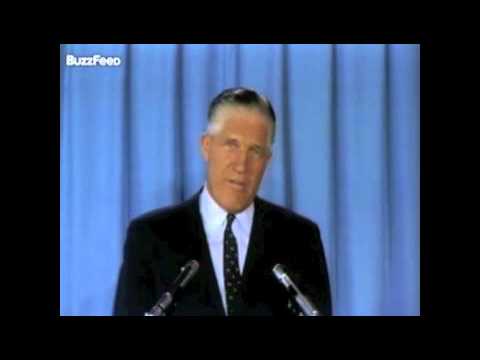
What I get from this short five minute version of Michigan Governor George Romney speaking at the 1964 Republican National Convention, is that he wasn’t necessarily against Senator Barry Goldwater and his presidential campaign. But he was worried about the Republican Party moving right and even Far-Right.

From 1964-68, the GOP was moving in transition from a center-right moderate conservative party with a solid progressive Northeastern base that Governor Romney was part of, to expanding the base of the party and moving south as well as west. Bringing in Christian-Conservatives from the South and Conservative-Libertarians from the West. Barry Goldwater was one of those Western Conservative-Libertarians.

Governor Romney and Governor Nelson Rockefeller and other Progressive Republicans, were worried that America wasn’t ready for this hardcore what was called back then conservative message,  but what today would be a conservative-libertarian message as far as Goldwater that was about individual freedom both economic and personal, as well as limited government and personal responsibility, as well as federalist when it came to government. And as a result the GOP would get wiped out in the 1964 general elections which was exactly what happened. And they were worried that the GOP couldn’t compete with just a small percentage of the electorate.

What Rockefeller and Romney got wrong, was that they were only correct in the short-term. Millions of Southern Democrats who voted for President Lyndon Johnson in 1964, voted for Richard Nixon for President in 1968. Congressional Republicans had a big comeback in 1966 by winning in the South in the House and Senate and winning out west.

Richard Nixon was part of the Progressive Republican base in California and New York, but being the great politician that he was, was also able to communicate with Goldwater Conservatives and Christian-Conservatives in the South, while retaining his Northeastern Republican Progressive base, to win the presidency in 1968 and win going way reelection in 1972.

But the remaking and renovation of the modern GOP that we see today started in 1964. Romney and Rockefeller, were wrong about the long-term affects that moving right would have on the GOP.

Tuesday, February 13, 2018

Thom Hartmann: Thom Hartmann Interviewing Gianno Caldwell- Where Are The Nelson Rockefeller Republicans?

Source:Thom Hartmann- Governor Nelson Rockefeller (R, New York) running for President, perhaps in 1960.
Source:The Daily View

"Thom Hartmann talks with Gianno Caldwell, Republican Strategist-Caldwell Strategic Consulting, Website: Gianno Caldwell.

If you liked this clip of The Thom Hartmann Program, please do us a big favor and share it with your friends... and hit that "like" button!"

From Thom Hartmann

The first few minutes of this interview is about Donald Trump and takes place in 2015. I’m not interested in Donald Trump for this piece, but if you are then you’re welcome to watch the video.

But I am interested in Nelson Rockefeller and what was the progressive wing of the Republican Party at least from the 1950s through the 1970s and perhaps even 1980s.

Nelson was a Progressive Republican along with Governor George Romney and a few Congressional Republicans like Senator Jacob Javits, Senator Charles Matthias, even President Richard Nixon and perhaps even Dwight Eisenhower when it came to economic policy and civil rights.

The Republican Party use to represent the Northeast and Midwest and had a conservative-libertarian wing in the West like Senator Barry Goldwater and others. Thanks to the civil rights movement of the 1960s and the 1960s in general , you saw Southerners who were anti-civil rights and anti-desegregation Democrats, move to the Republican Party. With Northern Republicans moving to the Democratic Party.

I wouldn’t say the Rockefeller Progressive wing of the Republican Party is dead, but certainly on political life support. Senator Susan Collins., Governor Larry Hogan of Maryland, Representative Charlie Dent and perhaps 30-40 House Republicans. But the Republican Party today is essentially Southern Bible Belt Christian-Conservative party, with conservative-libertarian wing in the west led by Senator Jeff Flake and others.

With a pro-business Northeastern wing of the Republican Party that is progressive if not liberal on social issues or at least neutral, but pro-business and wanting to see taxes and regulations down on business other than the environment and when it comes to safety.

Monday, February 12, 2018

Dartmouth College: Michael A. Cohen- Nelson Rockefeller: 'The 1968 Election & The Disappearance of Moderate Republicans'

Source:Dartmouth College- Professor Michael Cohen, giving a lecture about 1968 and the Republican Party.
Source:The Daily View

"Michael A. Cohen, Columnist, The Boston Globe, "Nelson Rockefeller ...

... the 1968 Election & the Disappearance of Republican Moderates." Book signing following talk: American Maelstrom: The Election of 1968 and the Politics of Division."

From Dartmouth College

I disagree with Michael Cohen right off the bat in his lecture about Nelson Rockefeller. Nelson wasn’t a Moderate, but was a Progressive and a Progressive Republican. Progressives in the real sense might look like Moderates compared with Socialists on the Far-Left who expect the national government to do practically everything for people. And in the case of Communists, want the national government to literally do everything for everybody. Perhaps even check people’s shoes to make sure they are tied correctly before the central government allows for people to leave their homes.

And Libertarians on the Right and if you’re talking about Anarchists on the Left, who don’t want government to do anything for everybody. That government in any form is corrupt and incompetent, and a form of enslavement.

Michael Cohen made my point that Nelson was a Progressive in his own lecture when he said that Rockefeller was a doer. He believed in government and that government can create positive change and do positive things for people. What do Progressives believe? They believe that progress can be made through government action. Limited government action since Progressives aren’t Socialists or Communists, and they are not even Liberals. Less ideological than Liberals and really everyone who is not a Moderate or Centrist and stress individual rights and individualism less than Liberals.

By the time 1968 comes around Richard Nixon essentially takes over the Republican Party in order to not just win the presidential election, but to serve him politically. By campaigning strongly for Congressional Republicans in 1966 and contributing to their comeback both in the House and Senate and making the GOP players in Congress again.

But also with Richard Nixon campaigned in the South that was traditionally Democrat, but Dixiecrat and even Confederate, and even religious as far as how they looked at their politics. What we today call the Christian-Right comes to the Republican Party by the late 1960s thanks to Richard Nixon and others. With Northeastern Republicans leaving the GOP except for Nelson and a few others and become Democrats. Which left Nelson Rockefeller without a major political party to run for president for.

Sunday, February 11, 2018

CBS News: Face The Nation- Flashback: U.S. Senator Frank Cannon- 'On Governor Nelson Rockefeller & Conflicts of Interest- In 1974'

Source:Face The Nation- U.S. Senator Frank Cannon, on CBS News Face The Nation in 1974, talking about President Gerald Ford's Vice Presidential nominee, Governor Nelson Rockefeller.
Source:The Daily View

"Then-Sen. Howard Cannon tells "Face the Nation" in 1974 how lawmakers were approaching concerns about Nelson Rockefeller's business empire and the conflicts of interest it might pose if he became vice president."

From Face The Nation

President Richard Nixon resigns the presidency in August of 1974 because of Watergate and his involvement in covering up that scandal coming to light because of his tapes. The House Judiciary Committee votes to impeach President Nixon that month as well with House Democrats clearly having the votes to impeach President Nixon by the full house.

The Senate Republican Leadership led by Minority Leader Hugh Scott, with other GOP Senators like Senator Barry Goldwater, goes to the White House to meet President Nixon and tell him that he’ll be impeached by the House and then convicted in the Senate. There were Senate GOP whip counts back then with only 20 votes or so in the Senate to vote for President Nixon’s acquittal. So this is a little background for why Governor Nelson Rockefeller from New York, was up for appointment by President Gerald Ford to be Vice President in the first place.

After the Congressional elections of 1974 where House Democrats add to the majority and pick up around 40 seats and Senate Democrats add 6 seats to their majority, President Gerald Ford appoints Governor Rockefeller to replace him as Vice President. If you’re familiar with this era or lived through it you know that Gerry Ford was President Nixon’s last Vice President and was appointed to that office in the fall of 1973.

But Nelson Rockefeller wasn’t your ordinary Governor. He’s part of the Rockefeller family dynasty and was worth what would probably be in today’s dollars in the hundreds of millions of dollars. He had a lot of business interests and at least potential conflicts of interest. When a new Vice President is needed and appointed before a presidential election, that person has to be confirmed by the entire Congress, not just the Senate. Which means the House gets to vote on the Vice Presidential nominee as well.

So that is what this Face The Nation interview was about in 1974 and while they were interviewing Senator Howard Cannon who was Chairman of the Rules Committee with his committee having jurisdiction over the Vice Presidency and vice presidential appointment.

And what the reporters on Face The Nation including a very young, beautiful, and adorable, Connie Chung from CBS News ( I must say ) interviewing Senator Cannon about Governor Rockefeller and his potential conflicts of interest because Rockefeller was such a wealthy man and had money and investments all over the country. They were asking Senator Cannon what he believed his committee would do as far as looking into those potential conflicts.

Friday, February 9, 2018

NBC News: Meet The Press- Governor Nelson Rockefeller: June 12th, 1960

Source:NBC News- Governor Nelson Rocekfeller, perhaps in 1974 after being nominated for Vice President of the United States.
Source:The Daily View

In 1960 then Governor Nelson Rockefeller appearing on NBC News Meet The Press, when running for President. The video for that interview is currently unavailable.

Nelson Rockefeller and Richard Nixon, seemed to have a political rivalry in the Republican Party even though ideologically they were pretty close. They were both basically Progressive Republicans. Certainly Governor Rockefeller was, but Rockefeller and Nixon were very similar on economic policy and probably foreign policy as well.

Nelly and Dick were both cold warrior anti-Communists who believed in a strong national defense and protecting America from Communist Russia with a strong national defense. They both supported the civil rights laws of the 1960s and the environmental protections of the 1970s.

And yet the way that the media back then would talk about Nelson Rockefeller and Richard Nixon, you would think they both came from different ideologically wings of the GOP. As if one was a Conservative and the other was a Moderate or Liberal. When the fact was both were basically Progressive Republicans in the classical and real sense. Not the stereotypical big government socialistic sense that Progressives especially in the Democratic Party today get labeled as.

It was Senator Barry Goldwater who was a Conservative-Libertarian Republican who strongly differed from the Rockefeller’s and Nixon’s in the Republican Party ideologically.

But when Meet The Press interviewed Governor Rockefeller in 1960, they were asking him questions implying that Rockefeller and then Vice President Nixon, were different ideologically. And that Rockefeller wasn’t sold on the candidacy of Vice President Nixon and wasn’t sure if he was going to support Vice President Nixon against Senator John Kennedy in the 1960 presidential election.

But the fact is Rockefeller and Nixon, were both essentially Progressive Republicans at least on economic and foreign policy, as well as social issues, who politically at least could’ve been strong running mates for a presidential election.

Thursday, February 8, 2018

Remember This: Cary Reich- Nelson Rockefeller: 'Biography, Accomplishments, Education & Legacy'

Source:Remember This- Nelson Rockefeller, perhaps before he was Governor of New York, in the 1950s.
Source:The Daily View

"Nelson Aldrich Rockefeller (July 8, 1908 – January 26, 1979) was an American businessman, philanthropist, public servant, and politician. He served as the 41st Vice President of the United States (1974–1977) under President Gerald Ford, and as the 49th Governor of New York (1959–1973). He also served in the administrations of Presidents Franklin Roosevelt regarding Latin America and Dwight Eisenhower regarding welfare programs. A member of the wealthy Rockefeller family, he was also a noted art collector, as well as administrator of Rockefeller Center."

From Remember This

To understand Nelson Rockefeller I think you have to understand the Republican Party of the 1950s, 1960s, and even the 1970s. Gerald Ford was a traditional Conservative Republican, but in the real sense and not with the Christian-Right and other Far-Right factions in America. But Richard Nixon I believe you could at least argue was a Progressive Republican and he was President in the 1970s.

After Gerald Ford leaves the presidency in January, 1977 is where the you see the Republican Party really start to change. You have the Conservative-Libertarian faction that Ronald Reagan and Senator Barry Goldwater were part of. But you also have the emergence of the Christian-Right come into the GOP. With the Progressive faction that Nelson Rockefeller was part of start to move out of the party and into the Democratic Party.

Before the Democratic Party and Republican Party, become more ideologically unified in the late 1970s with the GOP now being dominated by Conservative-Libertarians and the Christian-Right, as well as Moderate Conservatives, and the Democratic Party being dominated by Liberals, ( in the classical sense )  Progressives, ( in the classical sense )  and even Socialists in the real sense, as well as Southern moderates, the Republican Party had a real-life Progressive faction in it that Nelson Rockefeller was  big part of and perhaps the leader of it.

Progressive Republicans who were anti-Communist cold warriors, who believed in a strong national defense, strong but responsible law enforcement, limiting deficit and debt spending and even balanced budgets in good economic times, free trade. But people who believed in strong but responsible regulation of the economy like environmental, consumer, and worker protections, infrastructure investment, public education, and even raising taxes on people who could afford it to pay for government investments in the economy.

These Republicans weren’t Conservatives, Liberals, or Moderates, but Progressives who believed in progress through government action. And as a Progressive Republican Nelson Rockefeller was Governor of New York from 1959-74 became he became Vice President of the United States. And ran for President three times as well.

Wednesday, February 7, 2018

The Film Archives: Joe Nocera & Diana Henriques- 'The Stock Market Crash of 1987: Worst Day in Wall Street History'

Source:The Film Archives- Actor Michael Douglas, from The Streets of San Francisco. Not Wall Street 1987, which would've been more appropriate.
Source:The Daily View

"In finance, Black Monday refers to Monday, October 19, 1987, when stock markets around the world crashed, shedding a huge value in a very short time. The crash began in Hong Kong and spread west to Europe, hitting the United States after other markets had already declined by a significant margin. The Dow Jones Industrial Average (DJIA) fell exactly 508 points to 1,738.74 (22.61%).[1] In Australia and New Zealand, the 1987 crash is also referred to as "Black Tuesday" because of the time zone difference."

From The Film Archives

Similar to what happened with the Stock Market last Friday and this Monday, is that we had a major downturn of the market or in 1987’s case a crash when the basic fundamentals of the economy were strong. Not counting the high budget deficit and national debt. But with solid economic and job growth, low unemployment, and even seeing wages among middle class Americans going up. Before the 1929 Wall Street crash the economy was fairly strong as well and then the crash happened and shortly after that we were not only in a recession but the Greatest Depression and the economy hasn’t been worst since even with the Great Recession.

I believe as a non-economist that 1987 is where we see the negative consequences of what’s called Reaganomics. The theory being that you can cut taxes deeply and increase government spending dramatically and that somehow the new economic growth will pay for those new priorities. But the opposite actually happened.

When President Ronald Reagan comes to office in 1981 he inherited a budget deficit of about 40 billion dollars, which even in the early 1980s was a fairly small deficit. By the time President Reagan leaves office in 1989, we had a budget deficit of around 2 hundred-billion-dollars, which in the late 1980s was a large budget deficit. Today that would be over 400 billion dollars. The economy bounces back in 1988, but struggles in 1989 and we’re in a recession by 1990 that lasted about two years and costing President George H.W. Bush reelection.

If you look at recession of 1990-91, you had high interest rates, combined with inflation, with the high budget deficit contributing to the high interest rates. Because you had the Federal Government competing with the private sector to borrow money just to pay for its government operations.

America is now due for another recession simply because we’ve been growing as an economy coming up on nine straight years now and have growing since the Great Recession broke in the summer of 2009. The longest economic expansion at least in modern history. Rarely do you see a decade pass in America without at least one recession even if that recession is mild.

Assuming the Trump Administration continues to borrow money in huge chunks, if inflation and interest rates were come onto the scene again especially with the Federal Reserve feeling the need to raise interest rates to combat inflation because of higher consumer spending because of wages being increased, we may be in another situation like we were in the early 1990s. A recession to go with high budget deficits and a national debt. That will have to be addressed with major coming for people to prevent the economy from getting even worst.

Tuesday, February 6, 2018

Hip Hughes: Keith Hughes- 'Jim Crow and America's Racism Explained'

Source:Hip Hughes- Keith Hughes, talking about our Neo-Confederate Jim Crow laws.
Source:The Daily View

"The HipHughes Video Index: Google...

If you’re familiar with apartheid in South Africa where the Dutch South African Government, tried to separate the Dutch and other European-South Africans from the native South African population like the Zulu’s and other native Africans in South Africa, then I believe you at least have a vert good idea about what Jim Crow was and what Jim Crow laws are. The forced separating of the races simply because they’re of different race. Which as a non-constitutional lawyer and even a non-lawyer in any sense, looks on its face at least to me as unconstitutional. Under the Equal Protection Clause of the U.S. Constitution.

I blogged the last two weeks which now feels like months at this point because I was basically blogging about one man and his presidency in Woodrow Wilson. ( Not to get to personal ) And I blogged about the plusses and the minuses of the Woodrow Wilson Administration. Jim Crow is part of the minuses.

I mean, how stupid and ignorant can you possibly be as a human being as someone who doesn’t have any at least known mental defects that you would not only believe that the races should be separated because of their race, but that should be put into law by force. That people should have to be serrated simply because they have different complexions, hair, facial features, etc. But that is exactly what Jim Crow was which was both ignorant and stupid.

The reason why we got Jim Crow was because the Confederate States lost the Civil War. It’s really that simple and was a response and reaction to losing the Civil War. The South now knowing they can no longer actually own other human beings with slavery being wiped out and responded by saying that if they can no longer treat Africans as animals literally like farmers who own horses and cattle, that they would instead treat Africans as second-class citizens in America. And deny them their constitutional rights that all Americans are entitled to simply because they’re American citizens .

That is exactly what Jim Crow was and there really isn’t nice way of putting this without being truthful and honest.

Monday, February 5, 2018

Crash Course: John Green- 'Progressive Presidents: U.S. History'

Source:Crash Course- The American Progressive President's from Crash Course.
Source:The Daily View

"In which John Green teaches you about the Progressive Presidents, who are not a super-group of former presidents who create complicated, symphonic, rock soundscapes that transport you into a fantasy fugue state. Although that would be awesome. The presidents most associated with the Progressive Era are Theodore Roosevelt, William Taft, and Woodrow Wilson. During the times these guys held office, trusts were busted, national parks were founded, social programs were enacted, and tariffs were lowered. It wasn't all positive though, as their collective tenure also saw Latin America invaded A LOT, a split in the Republican party that resulted in a Bull Moose, all kinds of other international intervention, and the end of the Progressive Era saw the United States involved in World War. If all this isn't enough to entice, I will point out that two people get shot in this video. Violence sells, they say."

From Crash Course

Once again talking about Progressives and progressivism and once again I feel the need to define progressivism and separate it from Liberals and liberalism and Socialists and socialism, regardless of whatever socialist faction you’re talking about.

Progressives are people who believe in progress through government action. That is basic, simplest, and best definition of it. Progressives are the least ideological of all the political factions and the most practical. You have Progressives on the Center-Left like Teddy Roosevelt and Progressives on the Center-Right like Newt Gingrich. Unlike let's say Socialists way over on the Left ( to be kind ) who believe that government should try to do practically everything for everybody. Even if they believe private enterprise and capitalism should still exist and aren’t Marxists. Like Senator Bernie Sanders today.

Or people like Libertarians who believe that government should do practically nothing and only the most mainstream of Libertarians today believe that government should even be policing the streets, protecting the borders, defending the country, and even managing the currency. But Libertarians like former Representative Ron Paul, believe that government should at least be doing these things.

You have Progressives who believe in a strong but limited public social safety net, workers rights, equal rights for all Americans, but who are also strong anti-Communists and are against authoritarianism of all forms including socialist dictatorships. And believe in a strong national defense and social security. Even limiting deficit spending especially when the economy is strong like President Lyndon Johnson.

So, Progressives aren’t the people you see today who want tax hikes on everyone and all sorts of new government programs for the people, while slashing the defense budget and trying to censor everyone they disagree with and labeling all of those people as bigots.

The Progressive President’s in American history at least in the 20th Century and in the 21st Century so far, are President Theodore Roosevelt, President Woodrow Wilson, President Franklin Roosevelt, President Harry Truman, President Lyndon Johnson, and President Barack Obama. You could even argue that President Dwight Eisenhower and President Richard Nixon, we're Progressives but coming from the Right, especially when it came to economic and foreign policy.

President Theodore Roosevelt, gave us the regulatory state to protect workers and consumer from predators, but not to run private business thorough government.

President Woodrow Wilson, gave us the progressive income tax and the Federal Reserve. As well as defeat authoritarianism in Europe during World War I.

President Franklin Roosevelt, gave us the New Deal which is the creation of the American safety net, as well as defeating Nazi Germany during World War II.

President Harry Truman, put the finishing touches ( so to speak ) on Germany and Japan during World War II. As long as create the national security state which went a long way in defeating Communist Russia during the Cold War. He also fought for but was unsuccessful in passing his Fair Deal agenda in Congress which would’ve been an expansion of the New Deal.

President Lyndon Johnson, gave us the Great Society which was an expansion of the New Deal with more public assistance to try to combat poverty in America. He also gave us the civil rights laws of the 1960s that gave African-Americans and really all Americans, the right under statue not to be discriminated against based on race, ethnicity, gender, or religion. As well as the right to vote for all American including African-Americans.

President Barack Obama, gave us the Affordable Care Act, which means all Americans are eligible for health insurance and that people who are too wealthy for Medicaid, but can’t afford private health insurance, are eligible for subsidies to help them pay for health insurance. As well as an expansion of the regulatory state with how Wall Street does business in response to the economic crash of 2008.

Progressives aren’t interested in creating a national government so big that state and local government’s become practically irrelevant because so much power is centralized with the national government and government becomes so big that people no longer have to make personal and economic decisions for themselves. And even be able to speak or think for themselves.

Progressives aren’t Communists but instead are anti-Communists. They just want everybody to be able to succeed in society and believe that government has a limited role in seeing that everyone can be successful. Which is what these Progressive President’s believed in.

Sunday, February 4, 2018

C-SPAN: Q&A With Brian Lamb- A. Scott Berg: Woodrow Wilson

Source:C-SPAN- historian Scott Berg, talking to CSPAN's Brian Lamb, about President Woodrow Wilson.
Source:The Daily View

"Our guest is Pulitzer prize-winning author, A. Scott Berg. He discusses his latest work, the newly released biography of President Woodrow Wilson titled, "Wilson." Berg points out that 2013 is the 100th anniversary of Wilson's inauguration as the nation's 28th President."

From CSPAN

I agree with Scott Berg as far as how consequential President Woodrow Wilson was. “We must create a world safe for democracy”, is the most famous and important quote of the Wilson Presidency. That is the foreign policy in one way or another that America has used and been a part of since his presidency, except for again perhaps Donald Trump who is more of a Nationalist and not so much interested in working with our allies when it comes to foreign policy. And when America does act in foreign affairs and national security, President Trump and his Administration tends to do it alone.

Almost every President since Woodrow Wilson has had their own version of this liberal internationalist policy that is about promoting, protecting, and defending, democracy around the world.

President Franklin Roosevelt and then later President Harry Truman, were our strongest liberal internationalist hawks. World War II being the perfect example of that where America conquered Nazi Germany and Fascist Italy, Imperial Japan, and knocked out those authoritarian regimes that were replaced with democratic government’s and democratic constitution’s.

President Dwight Eisenhower was perhaps our most cautious liberal internationalist President and believed in limited usage of our military power. And understood the importance of having a strong military like our other President’s, but understood perhaps the limits of American power and that we couldn’t do everything ourselves as a military power. Probably the most anti-Neoconservative President that we’ve had.

John F. Kennedy perhaps being the strongest anti-Communist President that we’ve had and strongest cold warrior that we’ve had as President as a liberal internationalist.

President Lyndon Johnson tried to literally wipeout communism in all of Vietnam and using almost exclusively American power to do that.

President Richard Nixon was  a strong anti-Communist himself but was the great negotiator and believed the best way to defeat communism and authoritarianism in general, was to open authoritarian regimes up to Western culture and freedom.

President Jimmy Carter was a strong liberal internationalist and anti-Communist himself as President, as well as a World War II Naval veteran, believed that communism wasn’t the only threat to freedom and human rights. And gave his best speech as President in 1977 about the importance and need for human rights and freedom and that communism wasn’t the only opponent of those things.

President Ronald Reagan, believed that America should no longer try to live with the Cold War, but win it by ending it. President Reagan, obviously didn’t win the Cold War and defeat the Soviet Union by himself with all the President’s I just mentioned going back to Harry Truman, all having a major role there. But President Reagan hated communism so much and the system that Russia had that it had to be defeated and eliminated and replaced with a more responsible governmental system.

President George H.W. Bush, saw a world post-Cold War where America would be able to trade and work with all of our new European allies and even ben able to work with Russia to keep the peace in Europe and protect democracy there, but also protect and defend democracy in other parts of the world. Like in Asia and Africa. The 1991 Gulf War wasn’t America against Iraq, but America, Europe, and even Arabian countries, against Saddam Hussein’s Iraq.

It took President Bill Clinton at least two years to develop his own foreign policy as President, but the Balkans in Southern Europe and the wars going on there is where you finally see the Bill Clinton Doctrine as President. That America wouldn’t stand by and watch authoritarian regimes try to wipeout ethnic groups and ethnic minorities in their own countries. And because of this foreign policy the Communist ethno-Seriban State of Yugoslavia, is no longer in existence.

And we now see democratic peaceful countries in the Balkans. And President Clinton worked with Europe and this was a American/European campaign against Yugoslavia. First during the Bosnian/Serbian conflict in Yugoslavia and then later in Albanian Kosovo.

President George W. Bush is where you see a break from America’s liberal internationalist foreign policy doctrine. He was a Neoconservative as President with the 9/11 attacks being the ignitor to this new right-wing authoritarian unilateral foreign and national security policy. The 2003 Iraq War as basically America and Britain, against Iraq because America didn’t like Saddam Hussein’s regime in Iraq. Saddam was brutal to his people as President of Iraq, but never before had we eliminated another dictatorial regime simply because we didn’t like them.

President Barack Obama, gets I believe most of his best marks as President in foreign affairs especially in his first term. You can say what you want about Libya today but America and Europe working together, with both France and Italy, having major roles there, stepped in to that civil war and crude the Quadafi Regime in Libya. Not just because we didn’t like the regime there but because the Libyan Military was about to crush 100,000 people in Benghazi and we not stepped in the Libyan Military would have massacred 100,000 of their own people simply to protect the Quadafi Regime.

Woodrow Wilson was obviously a flawed President and was a racist as President who believed that European-Americans were superior to African-Americans, simply because of their race. And was a s supporter of the Jim Crow segregationist laws of the South and these are horrible aspects of the Woodrow Wilson Administration.

But you’ll have a real hard time finding a President who had more of  an impact on America as they relate both to our economy with the Federal Reserve, the progressive income tax, and and support for workers rights, as well as foreign policy and national security, than President Woodrow Wilson.

I don’t believe we become the world superpower without President Wilson, at least not as soon as we did without him. And he deserves a lot of credit for these policies.

Friday, February 2, 2018

Learn Out Loud: 'American President Series- President Woodrow Wilson Biography'

Source: Learn Out Loud- President Woodrow Wilson: Democrat, New Jersey, 28th President of the United States.
Source:The Daily View

"Thomas Woodrow Wilson was the 28th President of the United States, in office from 1913 to 1921. A leader of the Progressive Movement, he served as President of Princeton University from 1902 to 1910, and then as the Governor of New Jersey from 1911 to 1913. With the Republican Party split in 1912, he led his Democratic Party to control both the White House and Congress for the first time in nearly two decades."

From Learn Out Loud

As I’ve blogged before I have mixed feelings about President Woodrow Wilson. Similar to how I feel about President Richard Nixon and President Ronald Reagan, President Lyndon Johnson as well.

One one side you have this brilliant foreign policy leader and President who literally is the father of the liberal internationalist doctrine. That was the American foreign policy with each President making their own amendments to that doctrine especially President George W. Bush who was a Neoconservative, that was about defending liberal democracy at home and abroad. Working with our allies to defend, protect, and promote liberal democracy and prosperity around the world. Work with friendly developing countries to promote and defend democracy and prosperity in those countries through foreign aide. President Wilson’s liberal internationalist doctrine, was the foreign policy doctrine of the Democratic Party all the way though President Barack Obama’s presidency.

And then on the economic front you have a pretty Progressive President in Woodrow Wilson. He expanded the regulatory state that was created by President Theodore Roosevelt with the creation of the Federal Reserve and creation of the national progressive income tax. He supported tariffs on foreign goods. He supported workers rights and even organized labor. He was in favor of creating public Unemployment Insurance that President Teddy Roosevelt first proposed as President, but like President Roosevelt President Wilson failed to get Unemployment Insurance through Congress.

But then you had this other side of Woodrow Wilson who along with being the father of America’s liberal internationalist foreign policy doctrine, President Wilson was also one of the father’s of Jim Crow laws and segregation among the races both in the public and private sectors. President Wilson had given life to the Southern Dixiecrat segregationist Neo-Confederate Governor’s in the South who didn’t see African-Americans has American citizens and perhaps even as human beings. And wanted them segregated from European-Americans through force. Who were in bed politically with the Ku Klux Klan and wouldn’t prosecute from for their terrorism against African and Jewish-Americans, As well as other racial and ethnic minorities in America.

You get Jim Crow and the segregationist policies out of the Woodrow Wilson Presidency and had he been successful in getting the League of Nations passed in Congress through the Senate and we’re talking about one of our greatest American president’s instead of being in the 20s of wherever he’s ranked but certainly in the middle of the pack.

But you can’t get Jim Crow out of the Wilson Presidency, just like you can’t get Watergate out of the Richard Nixon Presidency. Because of the lasting horrible legacy of Jim Crow that went all the way through the 1960s in America. That alone could make a good argument for President Wilson not being a mediocre President, but one of our worst ever.

Thursday, February 1, 2018

Mometrix Academy: 'President Woodrow Wilson's 14 Points'

Source: Mometrix Academy- with a look at President Woodrow Wilson's 14 Points.
Source:The Daily View

"Make sure you are prepared for your exam by reviewing Woodrow Wilson's 14 points. Know why he created them and how they affected the aftermath of WWI.

Mometrix Academy is the world's most comprehensive test preparation company. This channel will provide you with videos that will help you learn about many different subjects."

From Mometrix Academy

As I argued before President Woodrow Wilson wanted to create a world, or at least an America and Europe, that was safe for democracy. Where countries wouldn’t go to war with each other because times were good. Countries were at peace, free trading with each other, living in prosperity and freedom. I also argued that President Wilson was about 30 years ahead of his time on this front. Because what we got post-World War II with the United Nations, NATO, and in the 1950s with the European Union, was exactly that.

Free, democratic, wealthy nations, tend not attack other free democratic wealthy nations. Because those countries aren’t run by dictators who are simply looking to consolidate and expand their own power both inside of their country, but outside of their country. Because those countries tend to believe in at least some form of democracy. Whether it’s liberal democracy which is what America has. Or social democracy which is common in Europe.

And democrats whether they’re on the Center-Left or Center-Right, tend to believe in these values along with checks and balances and respecting one’s borders and territory. Dictators obviously look at things differently and are interested in power. Staying in power but also expanding their own base of power. Whether they’re on the Far-Left or Far-Right politically.

So in this sense at least Woodrow Wilson was a visionary in the same class as a Richard Nixon or George H.W. Bush when it came to foreign policy. Men who not only understood how today’s world worked and operated, but saw decades into the future for how the world could look into the future. Where countries would no longer be fighting each other. Especially developed free countries and that instead they would work together to not only project their won freedom and economies, but work to promoted democracy, freedom, and prosperity around the world. When it comes to vision President Woodrow Wilson doesn’t get enough credit for the visionary that he was as a foreign policy leader.